

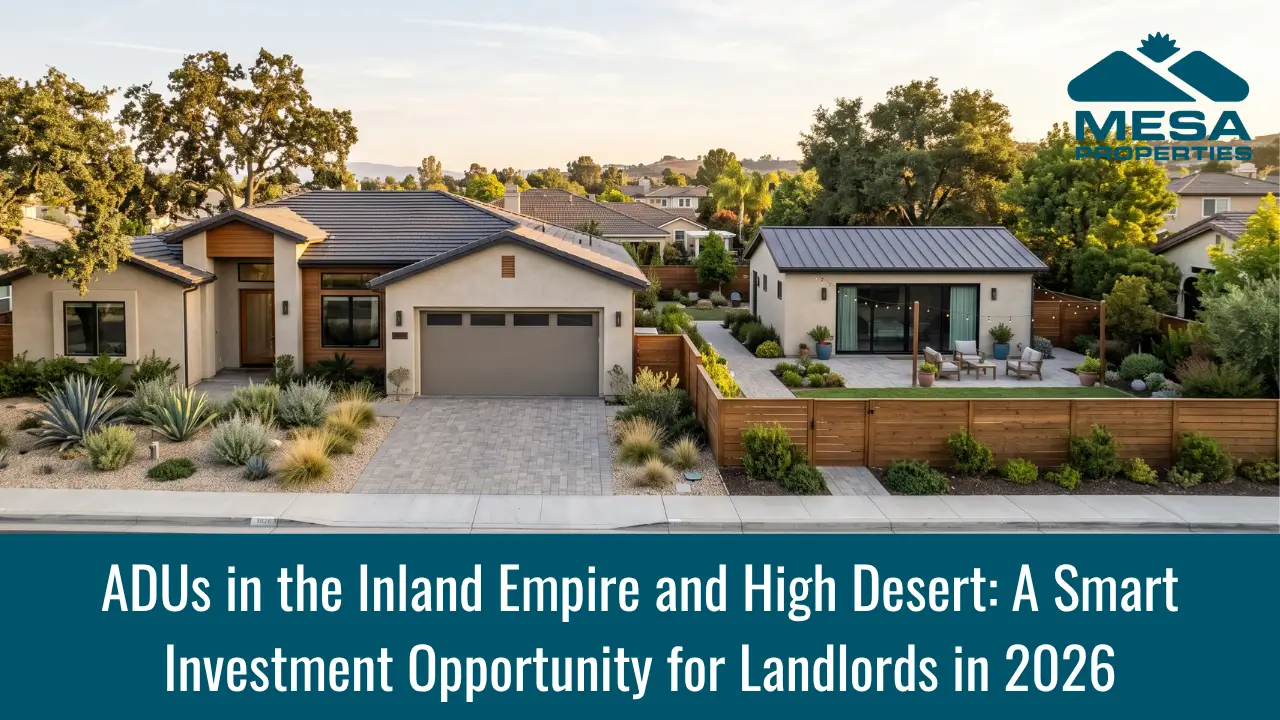
If you own rental property in our service area and haven't looked at ADUs recently, the landscape has shifted more than you might expect. A wave of new legislation signed in late 2025 took effect this year, and it directly addresses the barriers that used to make ADUs a harder sell for investors.
What was once a niche option for homeowners wanting a mother-in-law suite has turned into one of the more practical ways to add rental income to a property you already own.
Key Takeaways
New 2026 laws eliminated owner-occupancy requirements for most ADUs, meaning you can now rent out both the primary home and the ADU.
Multifamily property owners can build up to eight detached ADUs on a single lot under recent legislation.
Cities must now offer pre-approved ADU plans, which shortens permitting timelines significantly.
Previously unpermitted ADUs have a new legal pathway to compliance without a full code overhaul.
ADUs can meaningfully increase both monthly cash flow and resale value for Inland Empire and High Desert properties.
What Changed in California ADU Law This Year
For years, one of the biggest hurdles for investors was the owner-occupancy requirement tied to certain ADU types. That restriction is gone now for standard ADUs permitted after January 1, 2026, which means you're no longer required to live on a property in order to rent out both the main house and the accessory unit. That single change turns an ADU from a family living arrangement into a genuine income-producing asset for a rental portfolio.
On top of that, multifamily property owners got a major expansion. Owners of duplexes, triplexes, and fourplexes can now build up to eight detached ADUs on a single multifamily lot, roughly one per existing unit. For anyone holding multifamily property across Rancho Cucamonga, Fontana, or the Victorville area, that's a meaningful jump in potential unit count without needing to acquire additional land.
Faster Permits and a Path for Unpermitted Units
Permitting delays used to be one of the more frustrating parts of building an ADU, since timelines varied wildly from city to city. New rules now require every city to offer pre-approved ADU plans posted publicly, which cuts both design costs and approval time.
The law also creates a new path for owners who built an ADU years ago without proper permits. Rather than requiring a full code-compliance overhaul, the updated law focuses primarily on safety items like exits and sanitation, making it realistic to legalize a unit that might otherwise sit as an off-the-books liability.
Why This Matters for Inland Empire and High Desert Investors
Our service area is well positioned to take advantage of these changes. Lot sizes across much of the Inland Empire and High Desert tend to be larger than in coastal California markets, which gives owners more physical room to build without sacrificing the usability of the main property. Combine that with steady rental demand in cities like Ontario, Chino, and Apple Valley, and an ADU becomes a way to generate a second income stream from a property you already manage.
Financial Upside Beyond Monthly Rent
The income potential isn't limited to monthly cash flow. Adding a legally permitted ADU has been shown to boost property value on resale, since it effectively adds usable square footage and rental history to an appraisal. If you ever decide to sell, a documented, permitted ADU with a rental track record is a stronger selling point than an unpermitted structure that raises questions during due diligence.
Marketing an ADU effectively matters just as much as building one correctly. A poorly positioned listing for a backyard unit can sit vacant far longer than a main house would, simply because the pool of renters searching for a smaller, standalone unit is different from those searching for a full single-family home. Our marketing approach treats ADU listings differently for exactly this reason, targeting the renter profile that actually fits the unit.
What to Consider Before You Build
Before committing to a project, it's worth understanding your specific city's local ordinance, since jurisdictions can still impose reasonable standards around setbacks, height, and design even though the state law sets the outer limits. It's also worth confirming whether your ADU will be subject to a minimum rental term. Many local agencies still require a 30-day minimum, which rules out short-term or vacation rental use for most ADUs in our area.
Financing is another piece worth planning for early. Construction costs vary significantly based on whether you're converting existing space, like a garage, or building a new detached unit from the ground up. A detached unit typically costs more but tends to command higher rent and creates more separation between tenants, which many owners prefer for privacy and liability reasons. Understanding how ADUs interact with California's broader rent control framework is also worth reviewing before you finalize your rental strategy, since a new ADU is treated differently under state rent caps depending on when it was built and how it's used.
Frequently Asked Questions
Do I have to live on the property to rent out an ADU?
No, not anymore. As of 2026, owner-occupancy is no longer required for most standard ADUs, so you can rent out both the primary residence and the ADU. Junior ADUs, which are built within the walls of the existing home, still carry an owner-occupancy requirement.
Can I rent my ADU as a short-term or vacation rental?
In most cases, no. Many local jurisdictions still require ADUs to be rented for terms of 30 days or longer, which effectively rules out platforms built around short-term stays. Check your specific city's ordinance before assuming otherwise.
What if I already have an ADU that was never permitted?
New state law created a legalization path focused mainly on safety issues like proper exits and sanitation, rather than requiring a full code overhaul. It's worth having the unit evaluated to see whether it qualifies.
Turning Unused Space Into Real Rental Income
ADUs have gone from a niche housing option to one of the more practical tools available to Inland Empire and High Desert property owners this year. Between the removal of owner-occupancy restrictions, faster permitting, and expanded unit limits for multifamily lots, the barriers that used to make this a tough investment case have largely disappeared. The California Department of Housing and Community Development keeps an updated ADU handbook if you want to dig into the specifics of current state law before you start planning.
If you're weighing whether an ADU makes sense for your property, I'd be glad to walk through the numbers with you. Schedule a consultation with our team and let's talk about what your lot could support.